
Ravi Menon
BRD v0.9 is ready for review. Comments are due Mon 8 Mar; approval is targeted for Fri 12 Mar.
YouWrite the review request, then work through 61 comments.Week 3
Free from start to finish, with nothing to pay back. The Operator Program is Gantt Guild's live, 26-week training in project and product management. Run four projects through a full fiscal year, write every email, purchase order and Slack message yourself, and meet employers at three Career Days.
47 tools, 33 from GitLab's handbook.
Your own accounts.
Career Days, weeks 9, 17, 26.
Meet employers online.
Real deliverables,
reviewed live every Friday.
Your inbox, FY28
Ravi Menon
BRD v0.9 is ready for review. Comments are due Mon 8 Mar; approval is targeted for Fri 12 Mar.
YouWrite the review request, then work through 61 comments.Week 3
Ten moments from the year you'll run. The company, people and numbers are the fictional cases in Projects, For Real, set against GitLab's public handbook.
[ 47 tools · your own accounts ]
[ What you get ]
Everything a first-year project manager learns the hard way, compressed into 26 live weeks, with a review every Friday.
Tuition
$0
The whole program, not just the application. No deposit, no income-share agreement, and nothing owed if you leave or get hired.
The case
4 projects through one fiscal year
Ledger, Beacon, Run the Engine and Harbor, all competing for the same people and money.
Your portfolio
129
deliverables you write yourself: charters, RFPs, purchase requests, schedules, change orders, specs and queries.
Live, four days a week
About 6 live hours, all recorded. 20 to 25 hours a week in total.
Code from week one
SELECT type,
  AVG(inside_85)
FROM backtests
GROUP BY type;
Python from week 1, SQL from week 9. No experience needed.
Career Days
3 chances to get hired
Week 9Week 17Week 26
Hired in week 9? Take the job. You'll never owe us anything.
Your AI agent, supervised
An agent drafts. You check every number.
Claude Code or Codex, about $20 a month, paid to Anthropic or OpenAI. It's the one cost in the program, and we never see it.
YouCompute Ledger's estimate at completion from cost_ledger.csv.
AgentCPI 0.97, so EAC = BAC ÷ CPI = $619k.
YouThe overrun was partly a one-off. Show all four methods and the bottom-up estimate.
Reported: EAC $625k, range $619k to $632k, method stated.
[ The plan ]
Every stage ends with a live checkpoint. Meet the standard and you move up a rank. Miss it, and you get coached and try again within a week.
Learn how a 2,000-person company is wired, then plan all four projects: the business case, the charter, the RFP, the purchase request, and a schedule you can defend.
You'll be able to
Phase review: defend your integrated plan live. Pass, or revise and present again within a week.
The projects go live. A vendor's connector fails, a production incident hits 12% of page views, and a bank buys a subsidiary. You run sprints and flow, report honestly and control change.
You'll be able to
Phase review: a closure report, and a retrospective you facilitate live.
Mini Career Day in week 9
Follow Beacon from twelve customer interviews to general availability: vision, OKRs, discovery, prioritization, specs, design, metrics, experiments, pricing and launch.
You'll be able to
Phase review: a product decision presented and defended, plus the data exercise.
Mini Career Day in week 17
Your capstone, rebuilt in GitLab in depth, Jira and Confluence, Microsoft Project, and a spreadsheet someone else can audit. Then you automate the boring parts.
You'll be able to
Automations demoed live, including what happens when they fail.
No new reading. You publish your portfolio, sit a timed 160-question practice exam, rehearse interviews with working project managers, and present at Career Day.
You'll be able to
Career Day: online, with every employer in our network.
If your employer chooses Graduate Support, your training continues for another 6 to 12 months while you work. Either way, your portfolio and the book are yours to keep.
You'll be able to
Graduate Support is chosen and paid for by your employer. It never costs you anything.
[ Skills ]
Pick a point in the program to see where each skill stands. Levels are what our reviewers expect to see in your work by then.
[ The work ]
You don't answer quiz questions about a charter. You write the charter, and every other document a sponsor would sign, then defend it on Friday.
01Week 3Ledger
The requirements document needs sign-off from Tax, Payroll and every other affected team. One message tells each reviewer their section, the deadline and the approval date.
The standardCould a newcomer act on it without asking a single question?
Slack message
#proj-ledger
YouMon 1 Mar, 10:02
BRD v0.9 is ready for review. Please focus on your area: Tax §5.3, Payroll §5.4, EBAs §5.6.
Comments by Mon 8 Mar. Approval targeted for Fri 12 Mar.
61 comments, 58 resolved
02Week 8Ledger
A three-year contract has to clear sanctions screening, security, privacy, legal and negotiation before FP&A, the VP of IT and the CFO approve it. You write the request and walk it through every gate.
The standardEvery approver can see the need, the evidence and the money on one page.
Purchase request
Spendwise, Inc.
Reviews
Approvals
03Week 7Ledger
The plan says 82 days. You model every activity as a range, run the schedule 20,000 times in Python, and find the plan's own date comes true 37% of the time. Then you recommend a date you can defend.
The standardNo date without a network and a probability behind it.
Python
$ python ledger_monte_carlo.py
04Week 14Run the Engine
At 13:40 a feature flag reaches 100% of groups and epic boards start timing out. You run the incident channel, mitigate, then write the blameless review and its corrective actions.
The standardYou're the incident lead for 30 minutes, in a live simulation.
Incident
Epic boards timing out for large groups
05Week 14Harbor
The bank buys a subsidiary and wants 2,000 more repositories moved before its change freeze. On a fixed-price contract, you estimate the work, price it and write change order CO-1.
The standardScope, estimate, price and approvals in writing before any work starts.
Change order
Meridian Bank, SOW-4471: subsidiary repositories
06Week 19Beacon
Forecast accuracy is flat at 82%. You query it by forecast type and find epics improved nine points while the mix shifted toward them. Report by type, never only blended.
The standardEvery number comes with the query that produced it.
SQL
SELECT quarter, type,
       ROUND(100.0 * AVG(inside_85)) AS pct
FROM forecast_backtests
GROUP BY quarter, type;
| type | Q3 | Q4 |
|---|---|---|
| milestone | 84 | 85 |
| epic | 71 | 80 |
| all | 82 | 82 |
[ The case ]
Real companies run many projects at once, competing for the same people, money and executive attention. You run all four, week by week, from February 2027 to January 2028, inside an all-remote software company modeled on GitLab's public handbook.
LedgerInternal program, plan-driven
An IT program to move 2,000 employees off an aging expense tool that takes eleven days to reimburse, before its support ends on 31 December. Sarbanes-Oxley controls apply to everything.
Ledger in FY28
What goes wrong
The vendor's single sign-on connector fails testing on 11 August. Third-quarter spending runs $40k over Finance's allocation. Card feeds from 22 providers threaten the date.
Some of what you write
BeaconProduct development, monthly releases
A product team builds delivery forecasts (“85% likely by 5 November”) into GitLab's milestones and epics, from twelve customer interviews to general availability.
Beacon in FY28
What goes wrong
A security fix and a production incident take about 30% of the team's capacity in August. The team's own forecast says GA will miss, so scope is cut and the date holds.
Some of what you write
Run the EngineOngoing operations, Kanban and flow
The same engineers who build Beacon also own bugs, security fixes and performance for a large product area. Work that never ends needs flow, not sprints.
Run the Engine in FY28
What goes wrong
A feature flag reaches 100% of groups at 13:40 UTC on 3 August. Within 48 minutes, 12% of epic board views are failing. The month's error budget ends 96% spent.
Some of what you write
HarborCustomer engagement, fixed price, agile delivery
Professional services moves Meridian Bank's 3,000 developers to a dedicated GitLab instance: 8,000 repositories, 40 pipelines and training, for a fixed fee of $420,000.
Harbor in FY28
What goes wrong
The bank buys a subsidiary and wants 2,000 more repositories moved before the freeze. In a customer review, its platform lead projects a February finish.
Some of what you write
[ How we train ]
High standards, real conditions and live review every week. Nobody gets carried, and everyone who wants to finish gets the coaching to do it.
You don't answer quiz questions about a charter. You write the charter, the RFP, the purchase request and the status report, to the standard a sponsor would sign.
129 deliverablesYour work goes on the screen in front of the cohort and gets challenged against that week's written standard. Meet it, or revise and show it again.
26 reviews, 3 phase reviewsA vendor's connector fails. A feature flag breaks a page for 12% of users. A bank buys a subsidiary mid-project. You handle each one as it happens.
The book's failures, run liveYou create your own accounts in the tools GitLab's handbook documents, on free plans and trials. Nothing is set up for you, just like a real first week.
47 tools, 1 paidPython from day one and SQL from week 9, on a real database engine on your own laptop. By the end you query, simulate and automate your own reports.
A lab every weekEvery week you put an AI agent to work, then verify what it produced: the query, the schedule, the contract clause. Your judgment is what you're trained for.
26 agent labs[ Hands on ]
Project managers who can answer their own questions get trusted with bigger ones. Every week has a lab, built on the four projects' own data.
No coding background needed. The labs start from installing Python.
SELECT quarter, type,
       SUM(inside_85)                    AS inside,
       COUNT(*)                          AS total,
       ROUND(100.0 * AVG(inside_85), 0)  AS accuracy_pct
FROM forecast_backtests
GROUP BY 1, 2
ORDER BY 1, 2 DESC;quarter | type | inside | total | accuracy_pct
Q3 | milestone | 420 | 500 | 84
Q3 | epic | 71 | 100 | 71
Q4 | milestone | 170 | 200 | 85
Q4 | epic | 320 | 400 | 80ReviewOverall accuracy is 82% in both quarters, yet epics improved nine points. The mix shifted toward epics. Report by type, never only blended.
def beta_pert(o, m, p):
    a = 1 + 4 * (m - o) / (p - o)
    b = 1 + 4 * (p - m) / (p - o)
    return o + rng.beta(a, b, RUNS) * (p - o)

finish = {}
for act, (estimate, preds) in ACTIVITIES.items():
    start = np.max([finish[p] for p in preds], axis=0) if preds else 0
    finish[act] = start + beta_pert(*estimate)

print(f"P(<= 82 days) {np.mean(finish['Q'] <= 82):.0%}")P(<= 82 days) 37%
P50 83.2 days P80 86.6 days P95 90.2 daysReviewThe plan's own date comes true in 37% of 20,000 runs. Commit to a date with a fallback, and watch the card feeds.
YouCompute Ledger's earned value by control account from cost_ledger.csv and give me the estimate at completion.
AgentCPI 0.97, SPI 0.95. EAC = BAC ÷ CPI = $619k.
YouThe integrations overrun was partly a one-off vendor defect. Show all four EAC methods, plus the bottom-up estimate from the control account owners.
AgentBAC ÷ CPI $619k. AC + (BAC − EV) $611k. With CPI × SPI $632k. Bottom-up $625k.
Your reportEAC $625k (bottom-up), range $619k to $632k, with the method and the reason stated. The agent's first answer was arithmetic; the judgment was yours.
[ The business ]
The project managers who get the hard projects understand the business. Alongside the four projects you work through the core of a first-year MBA: 58 chapters in seven subjects, each with a case and an exercise. They're the subjects at the heart of required curricula like Harvard Business School's.
Run the Five Forces on Larkspur, a $140M freight-software company, then decide whether to build, buy or partner.
Take a software bundle through the five revenue-recognition steps; decide what Ledger capitalizes.
Compute Larkspur's cost of capital, then value the option to expand Beacon.
Segment an outdoor brand's customers, price a new tent line and design a channel strategy.
Apply Little's law to Harbor's migration pipeline; forecast demand and set order quantities.
Redesign a failing global team and prepare a negotiation.
Write a start-up's riskiest hypotheses, design the cheapest tests, and pitch its seed round.
Gantt Guild is not affiliated with, or endorsed by, Harvard University or Harvard Business School.
[ Your own accounts ]
GitLab documents how it works in a public handbook, right down to the tools. You use the same ones, on free plans, developer accounts and trials you create yourself. Enterprise-only systems like Coupa and Workday are studied from real documents, then reproduced in free tools.
Your total
~$20/month
For one AI agent, Claude Pro or ChatGPT Plus, paid to Anthropic or OpenAI. Everything else is a free plan, a developer account or a trial.
[ What it costs ]
Not a free trial, a free first module or a free application. Six months of live training, feedback and Career Days cost you nothing, now or later.
Employers fund it. A company that hires a graduate it met through us pays us a flat placement fee once they start, and some pay us to keep developing the person they hired. The fee never comes out of your pay, and it only works if we train people well.
Bill to: you
| 26 weeks of live training | $0.00 |
| Friday reviews and one-to-one feedback | $0.00 |
| Projects, For Real, all 1,750 pages | $0.00 |
| Three Career Days with employers | $0.00 |
| Income-share agreement | None |
| If you leave early | $0.00 |
| If you get hired | $0.00 |
| Total due to Gantt Guild | $0.00 |
Your one outside cost: an AI coding agent for the weekly labs, about $20 a month (Claude Pro or ChatGPT Plus), paid to the provider, never to us. About $120 over six months.
[ Who it's for ]
People with a college degree or equivalent experience who want to run projects for a living. Career returners, career changers and people who left college are all welcome.
A good fit if
Not a fit if

A degree, and job posts that want three years of experience. Leave with a year of real work to show.

Back after caring for family, illness, service or a move. Get current on the tools and on AI, fast.

Teachers, nurses, store managers, engineers: you already run things. Learn the language and the tools.

No degree? Equivalent experience counts, and so does everything you've organized and delivered.
[ Career Days ]
Employers meet the cohort online in weeks 9, 17 and 26. If you get an offer in week 9, take it. Leave with nothing to pay back, or keep attending if your new job allows.
Integrated project plans, defended live.
Sprints, earned value, an incident review and a closed project.
Complete portfolios, tool builds and an AI playbook.
For employers
Career Days cost nothing to attend. When someone you met through us joins your team, you pay a flat $5,000, not a percentage of salary. Graduate Support adds 6 to 12 months of training, from $8,000. Graduates never pay, and nothing limits where they can work.
[ Compare ]
| Online certificate courses | Coding bootcamps | Full MBA programs | Gantt Guild | |
|---|---|---|---|---|
| Cost to you | Subscription or course fees | Tuition, or a share of future pay | Tuition, often six figures | $0. About $20 a month for your own AI agent |
| Format | Self-paced video and quizzes | Live, often full-time | Live cases, one to two years | Live online, 20 to 25 hours a week, 26 weeks |
| What you produce | Quiz scores and a certificate | Software projects | Case discussions and papers | 129 project artifacts across four projects |
| Real workplace tools | Rarely | Developer tools | Rarely | 47 tools, many from GitLab's handbook |
| Code | None or optional | The focus | Rarely | Python, SQL and an AI agent, weekly |
| Business core | No | No | Yes | Seven MBA core subjects |
| Live review of your work | Automated or peer-graded | Yes | Yes | Every Friday |
| Path to a job | Job boards | Career services | Recruiting season | Three Career Days with hiring employers |
Comparisons describe typical programs in each category, not any specific provider.
[ Your instructor ]
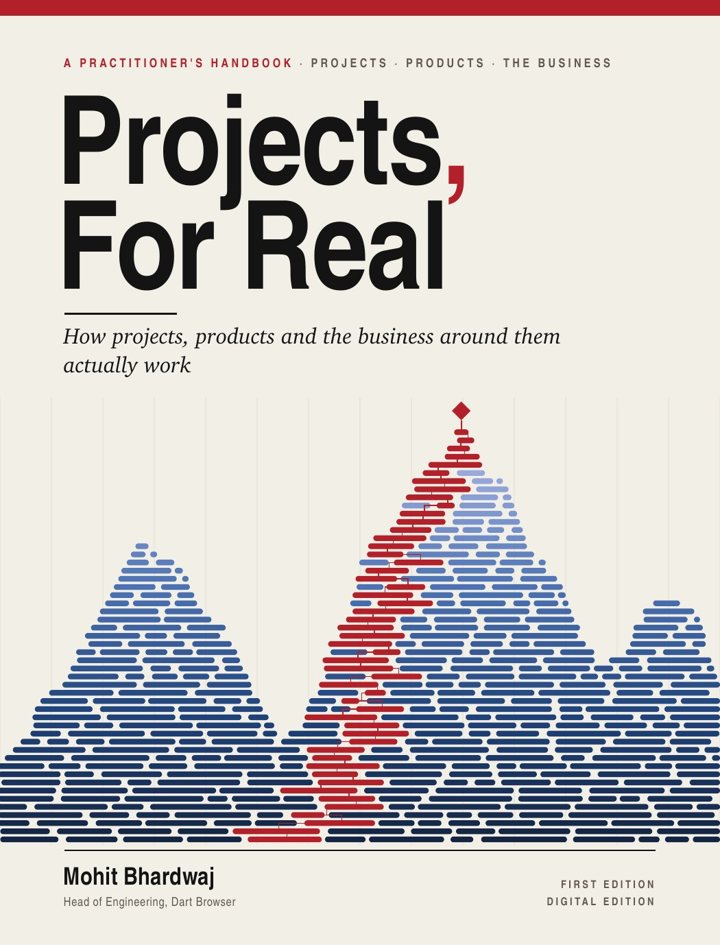
Mohit Bhardwaj is the founder and Head of Engineering at Dart Browser and the author of Projects, For Real. He teaches every live class himself.
The book follows four projects through a full fiscal year inside one company and shows where they collide: over the same people, the same budget cycle and the same executives' attention. It explains the theory, then shows exactly what the documents, meetings and decisions look like. It's released openly, and it's the program's textbook.
[ From the blog ]

A feature flag reached 100% of a large SaaS platform at 13:40 UTC. Forty-eight minutes later, 12% of epic board views were failing. What happened, why four layers of defense lined up, and what a project manager should do in the room and after it.

The evaluation team picked a vendor on 30 April. The contract was signed on 4 June. In between: sanctions screening, security, privacy, legal, negotiation, FP&A and a three-level approval chain. The path, the documents and the mistakes that cost a week.

At the end of August, Ledger had spent $363k against $370k planned. A budget report would call that good news. Earned value showed the project behind schedule and over cost, pinned the cause to one control account, and forecast the final cost within 1%.
[ FAQ ]
Can't find yours? A person reads every email.
Yes. No tuition, no deposit, no income-share agreement, nothing owed if you leave or get hired. The only outside cost is an AI agent subscription of about $20 a month, which you pay to Anthropic or OpenAI directly.
Employers. A company that hires a graduate it met through us pays us a flat fee once they start. It never comes out of your pay, it never limits where you can apply or work, and you never need our permission to take, turn down or leave any job.
No. You create your own accounts, mostly on free plans, plus free developer accounts and trials in the weeks that need them. Setting up your own workspace is part of the training.
20 to 25 hours a week for 26 weeks, with about 6 hours of live sessions you can catch up on from recordings.
No. Python starts from installation in week 1 and SQL in week 9.
Anyone 18 or older who lives in the US and is authorized to work there, with a college degree or equivalent experience. Career returners, career changers and people who left college are all welcome.
It's what we call graduates of the Operator Program: people who can run real work end to end, from the business case to the closing report. You earn a rank at each stage: Planner, Project Lead, Product Lead, Specialist, then Operator.
[ Cohort 1 · applications open ]
Applying takes about ten minutes. A person reads every application, and you'll hear from us within 7 days.